An exhibition Russian Sailing Ships in Latin America opened at the Civic Chamber of the Russian Federation
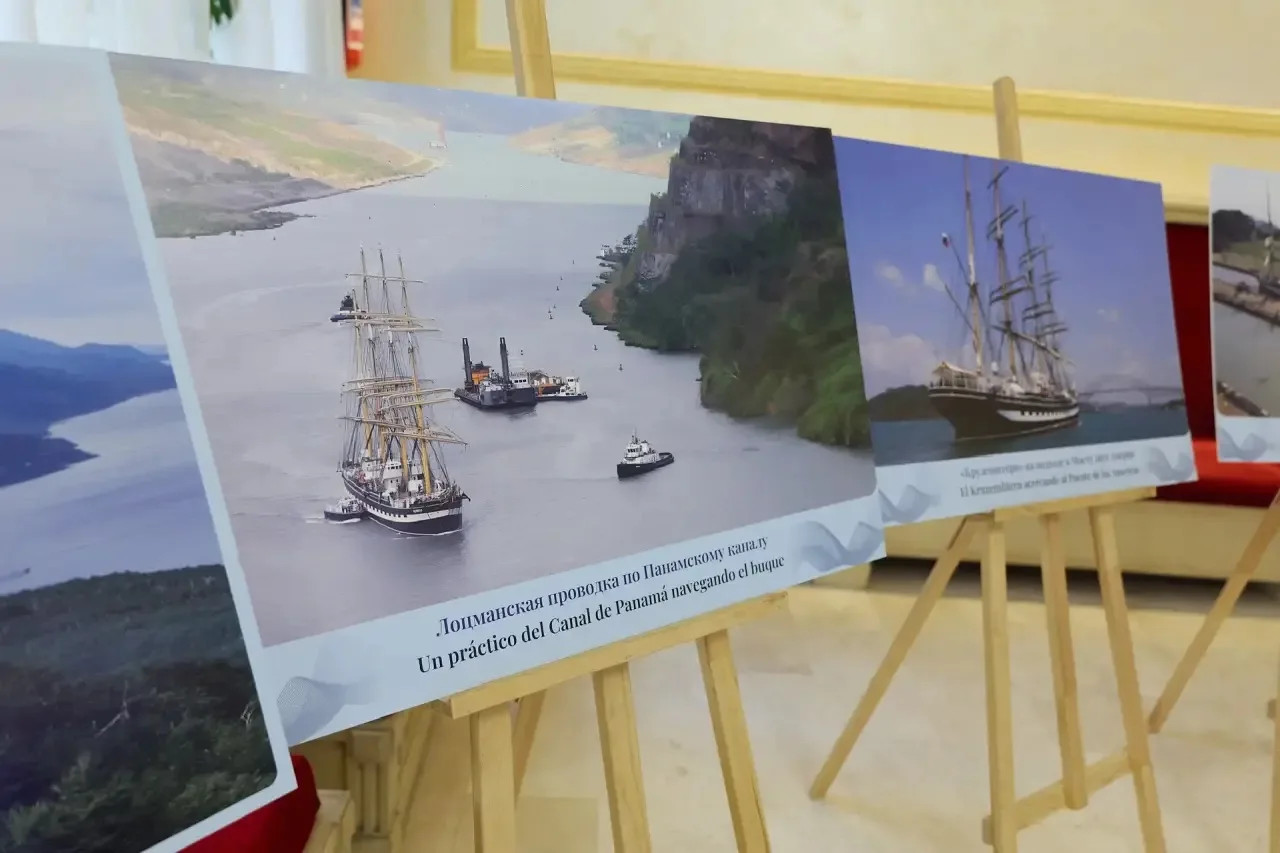
The main characters of the exhibition became the sailing ships Sedov, Pallada and Kruzenshtern, the latter turning 100 this year.
The exhibition, comprising 20 posters, features images from the unique voyage of 2019–2020, dedicated to the 200th anniversary of the discovery of Antarctica by F.F. Bellingshausen and M.P. Lazarev.
The first guests at the exhibition were representatives of public organisations from Russia and Serbia, including the Imperial Orthodox Palestinian Society, the Russian Olympic Committee, the Russian Union of Writers and the Union of Artists of Russia.
Russian sailing ships underwent a tremendous ordeal — a major expedition to Antarctica, sailing along the coast of Latin America and visiting several countries, noted Nikita Anisimov:
The visits of our sailing ships to each country are a significant event.
During the exhibition’s ceremonial opening, the captains of the sailing ships spoke about the circumnavigation expedition and its significance. Sharing his impressions of international sea routes, M.P. Eremenko, the master of the sailing training ship Kruzenshtern, emphasised that the ship's crew, by flying the Russian flag, proudly bears the honor of the Russian fleet:
‘And to the young people undergoing practical training with us, we give that very push into life. After all, young people are changing rapidly – they have different priorities, a different perspective. We need to teach them to love their motherland, to instil discipline and order, because they are the future officers. And what we give them on our sailing training ships is exactly how they will behave when they become commanders.’
The barque Kruzenshtern has a history stretching back a century. It is currently used to provide basic shipboard training and teach maritime professions to cadets from educational institutions under the Russian Federal Agency for Fishery. The vessel also takes cadets from other countries on board. Around 140 cadets undertake their practical training during each voyage.
V.Yu. Nikolin, captain of the sailing training ship Sedov, spoke about the unique Arctic voyage during the pandemic:
‘Initially, the crew had planned to return to their home port via the Panama Canal, but the canal was closed due to the pandemic. The ship arrived in Vladivostok, where it moored at the Pacific Fleet’s main base in the city centre. It was decided to return via the Northern Sea Route through the Arctic. The ship sailed under sails for half the route. This was the first sailing ship of such a class to have sailed the Northern Sea Route in a single voyage in 140 years.’
Events dedicated to the history of Russia and the Soviet people’s victory in the Great Patriotic War were held in ports of Argentina, Brazil, Uruguay and Chile. The most memorable moments were the rendezvous of three sailing ships in the South Atlantic and a 200-mile regatta in the South Sandwich Islands area in the conditions of a storm with a force of nine on the Beaufort scale.
The exhibition featured works by well-known photographers from Kaliningrad and St Petersburg: V.V. Semidyanov, V.N. Pritchenko, E.A. Romanenko, and E.E. Molchanov. KSTU assisted in the selection of photographs.
The exhibition will continue its tour of cities across Russia and Latin America: in 2026, it will be presented in a number of countries in the region, including Havana.
The exhibition, comprising 20 posters, features images from the unique voyage of 2019–2020, dedicated to the 200th anniversary of the discovery of Antarctica by F.F. Bellingshausen and M.P. Lazarev.
The first guests at the exhibition were representatives of public organisations from Russia and Serbia, including the Imperial Orthodox Palestinian Society, the Russian Olympic Committee, the Russian Union of Writers and the Union of Artists of Russia.
Russian sailing ships underwent a tremendous ordeal — a major expedition to Antarctica, sailing along the coast of Latin America and visiting several countries, noted Nikita Anisimov:
The visits of our sailing ships to each country are a significant event.
During the exhibition’s ceremonial opening, the captains of the sailing ships spoke about the circumnavigation expedition and its significance. Sharing his impressions of international sea routes, M.P. Eremenko, the master of the sailing training ship Kruzenshtern, emphasised that the ship's crew, by flying the Russian flag, proudly bears the honor of the Russian fleet:
‘And to the young people undergoing practical training with us, we give that very push into life. After all, young people are changing rapidly – they have different priorities, a different perspective. We need to teach them to love their motherland, to instil discipline and order, because they are the future officers. And what we give them on our sailing training ships is exactly how they will behave when they become commanders.’
The barque Kruzenshtern has a history stretching back a century. It is currently used to provide basic shipboard training and teach maritime professions to cadets from educational institutions under the Russian Federal Agency for Fishery. The vessel also takes cadets from other countries on board. Around 140 cadets undertake their practical training during each voyage.
V.Yu. Nikolin, captain of the sailing training ship Sedov, spoke about the unique Arctic voyage during the pandemic:
‘Initially, the crew had planned to return to their home port via the Panama Canal, but the canal was closed due to the pandemic. The ship arrived in Vladivostok, where it moored at the Pacific Fleet’s main base in the city centre. It was decided to return via the Northern Sea Route through the Arctic. The ship sailed under sails for half the route. This was the first sailing ship of such a class to have sailed the Northern Sea Route in a single voyage in 140 years.’
Events dedicated to the history of Russia and the Soviet people’s victory in the Great Patriotic War were held in ports of Argentina, Brazil, Uruguay and Chile. The most memorable moments were the rendezvous of three sailing ships in the South Atlantic and a 200-mile regatta in the South Sandwich Islands area in the conditions of a storm with a force of nine on the Beaufort scale.
The exhibition featured works by well-known photographers from Kaliningrad and St Petersburg: V.V. Semidyanov, V.N. Pritchenko, E.A. Romanenko, and E.E. Molchanov. KSTU assisted in the selection of photographs.
The exhibition will continue its tour of cities across Russia and Latin America: in 2026, it will be presented in a number of countries in the region, including Havana.