High-tech complexes installed at KSTU Engineering Competencies Centre
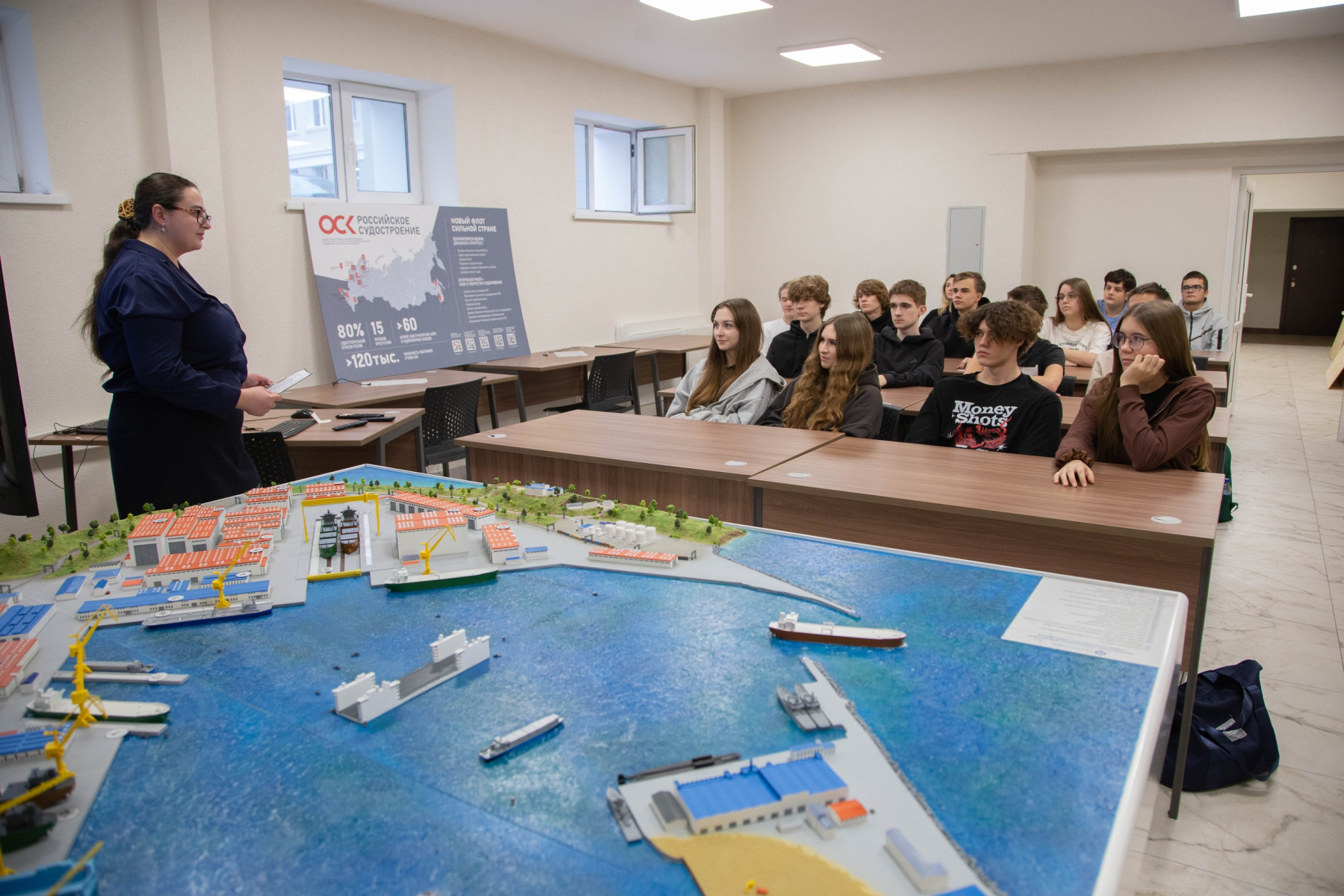
As part of the project to create shipbuilding engineering classes (Agreement between the Ministry of Science and Higher Education of the Russian Federation and KSTU ‘On the provision of a grant in the form of subsidies from the federal budget to higher education institutions for the creation, in collaboration with universities and industrial partners, of engineering classes for the aircraft manufacturing, shipbuilding and innovative transport industries’), in order to develop and promote engineering education, the university acquired four high-tech complexes that will allow schoolchildren and university students to master advanced methods of ship design, construction and operation in virtual and practical environments.
At the Engineering Competencies Centre, a laboratory for the logistics of modern shipbuilding complexes was established. This complex allows advanced study of specialised topics: Fundamentals of Shipbuilding, Shipbuilding and Ship Repair Technology, Organisation of Technological Work and Quality Control in Shipbuilding, Technological Processes for the Manufacture and Installation of Shipbuilding Equipment. Specialised software with 3D visualisation and interactive animation simulates the entire shipyard cycle, from the assembly to logistics and ship repair.
The laboratory features digital analogues of ship-lifting mechanisms, cranes and auxiliary equipment with detailed routes for moving structures. An interactive model of a typical shipyard demonstrates the layout of production areas, the location of workshops, and the stages of technological processes.
Main areas of research and training:
- optimisation of logistics processes at shipbuilding enterprises;
- study of the ship hull assembly stages;
- analysis of ship lifting structures and their technical characteristics;
- development of equipment for the assembly and installation of ship structures;
- modelling of the interaction between the elements of a ship’s hull
Engineering solutions in shipbuilding are demonstrated using the Virtual Training Complex Virtual Ship – Dry Cargo Vessel.
The VR training complex allows interactive study of the architecture and engineering systems of dry cargo ships. A software platform integrates a three-dimensional model of the ship, which includes details down to individual components and assemblies, and it supports the immersion in a virtual environment using VR glasses.
The complex offers the following capabilities:
- study of ship’s compartments layout;
- training in the operation of mooring and anchoring devices, as well as firefighting systems;
- study of terminology and standards in the shipbuilding industry;
- visualisation of loading/unloading and ship control processes in standard and emergency situations.
The shipbuilding engineering course covers topics such as ship electrical power engineering and ship equipment automation. For these purposes, an Electrical Installation and Adjustment of Industrial Automation Systems simulator was purchased. It is a virtual model of a real room with electrical installation booths inside it for demonstrating and conducting training exercises on electrical installation and industrial automation system setup technologies. Each virtual workstation is fitted with a workbench for metalwork, a box with equipment and a storage space for electrical equipment that will be used during the installation.
Simulator capabilities:
- gaining experience in electrical installation work;
- studying technical documentation;
- gaining experience in designing circuits and their parameters;
- gaining experience in the use of frequency converters and programmable logic controllers;
- gaining experience in troubleshooting.
Virtual training stand Instrumentation and Automation, Technical Means of Control and Measuring Devices and Automation.
The simulator is a virtual analogue of the real training stand Instrumentation and Automation and allows you to study the following topics: Automation of Standard Technological Processes, Software Control Systems, Elements of Automation Systems, Sensors and Actuators of Field-Level Control Systems.
The simulator stand offers the following capabilities:
- study of the connection diagram for sensors to the control and measurement system;
- study of the basics of passive and active sensors, taking into account real static and dynamic characteristics;
- study of mathematical models of real physical elements and devices.
Today, the Engineering Competencies Centre is a modern educational environment with a wide range of opportunities for schoolchildren and university students.