KSTU held a strategic planning session for agricultural technology classes
On 25 August, Kaliningrad State Technical University hosted a strategic project session entitled Agrotechnology Classes: From Efficient Solutions to Sustainable Development. The event took place in the Assembly Hall of Academic Building No. 1, as part of the August Pedagogical Conference. It focused on the development of agricultural technology classes in the Kaliningrad Region, the implementation of the university’s grant project AgroGeneration.39RF, and the formulation of plans for collaboration with schools for the 2026–2027 academic year.
The Ministry of Education of the Kaliningrad Region, Kaliningrad State Technical University, and the agro-industrial holding Zalesye collaborated to organise the session.
T.Z. Zabrodina, Head of the General Education Department at the Ministry of Education of the Kaliningrad Region, and V.I. Ustich, Vice-Rector for Academic Affairs, addressed welcoming remarks to the participants.
During the business programme, E. N. Gashenko, Director of the Centre for Pre-University Projects, presented the mechanisms for implementing the grant project AgroGeneration.39RF. The project envisages a two-level training system: a starting level for students in grades 7–8 (the Class Meetings: PROF_AGRO_Formula programme, 18 hours of intensive courses under the guidance of student mentors) and a basic level for students in grades 8–11 (5 specialised programmes, each consisting of 36 academic hours). Among the areas of focus are agronomy, animal husbandry and veterinary science, aquaculture, raw material processing, and digital technologies in the agro-industrial complex. Classes take place at university laboratories and partner enterprises, ensuring practice-orientated learning and the development of real professional competencies among schoolchildren.
Special attention was paid to the development of a successful graduate’s portfolio and the Olympiad marathon. Elena Nikolaevna spoke about involving schoolchildren in specialised Olympiads — AgroNTRI, Trajectory 4K, and Star of the Future — as well as in career-orientated events at KSTU: the quests Planet University, Smart Holidays, and Useful Saturdays. Winners of Olympiads from the list approved by the Ministry of Education and Science receive benefits when applying to KSTU — admission without entrance exams or 100 points on the Unified State Exam in the relevant subject, provided that the exam is passed with at least 75 points, and first-year students receive an increased scholarship of 25,000 rubles.
The partners' areas of responsibility were defined as follows: KSTU ensures the development of programmes and distance learning courses, as well as holding specialised Olympiads and competitions, whilst general education organisations support school students' projects and organise participation in the Olympiad marathon.
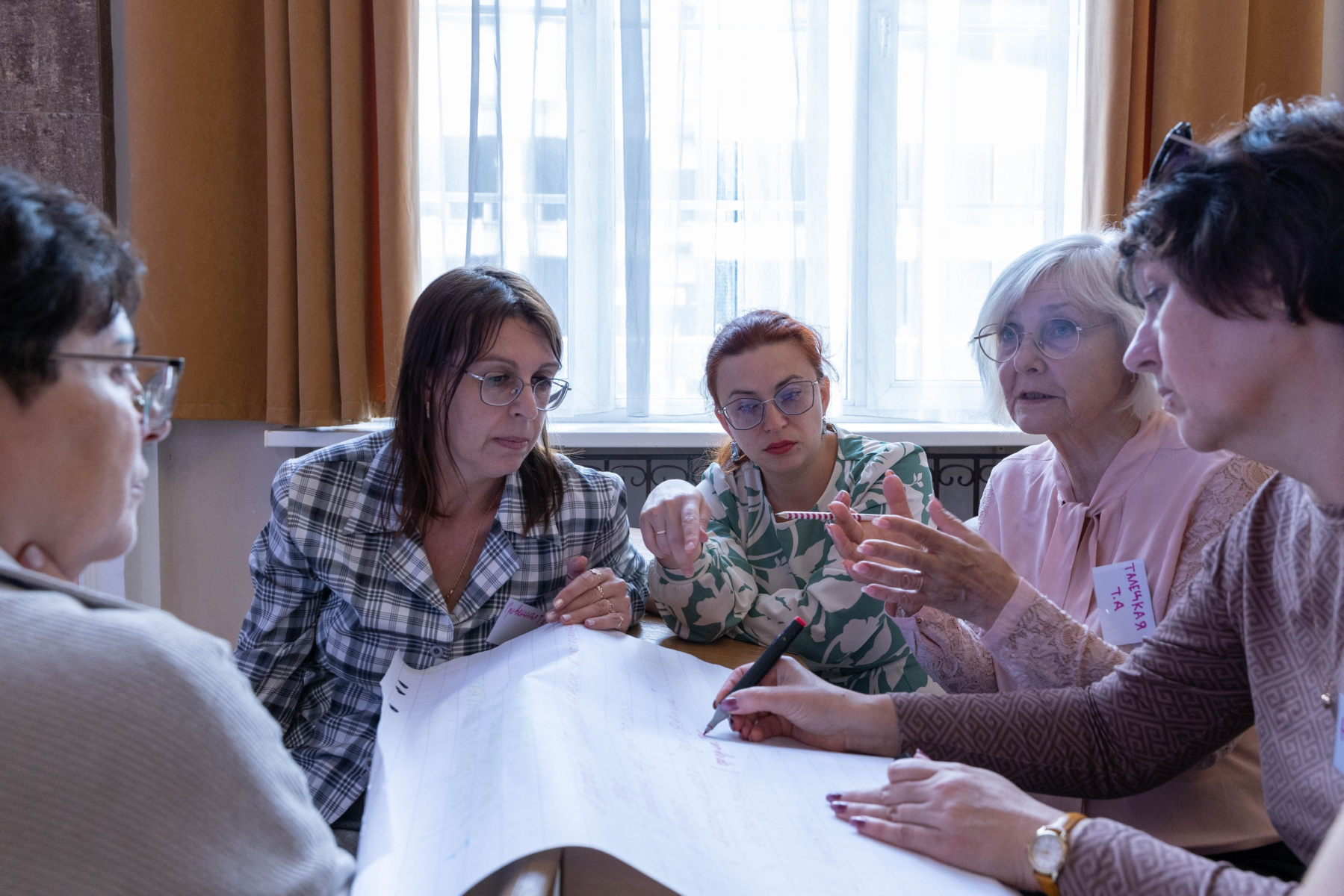
The key element of the session was the project intensive course — working in groups on cases related to current issues in the operation of agrotechnology classes.
Trajectory of Success — from the School Desk to the Agro-Industrial Holding, a case for teachers, aimed to create a step-by-step programme that would support students from the moment they chose a profession until they found employment in the agro-industrial sector. Within 45 minutes, the teams worked through five key stages: motivating schoolchildren to pursue professions in the agro-industrial complex; involving parents in choosing a future profession; immersing them in the agricultural process through excursions, master classes, and traineeships; preparing for exams with an emphasis on chemistry and biology as core subjects; and career support after school, including traineeships in real agricultural holding companies.
Working with the case studies was initiated and organised by T.A. Akimova, network interaction coordinator for AIH Zalesye and the Municipal Budgetary Educational Institution Zalesovskaya School, and E.R. Orlova, director of the AIH Zalesye training centre.
When developing the trajectories, the teachers took into account the real conditions of rural schools, the specifics of interaction with families, and the capabilities of local enterprises. The teams presented their solutions in the form of diagrams, presentations, and infographics. The final programs were evaluated based on five criteria: the feasibility of the proposed steps, consideration of the age-related characteristics of students, the active role of the family, the integration of practical training at agro-industrial enterprises, and the focus on developing competencies for successfully passing the Unified State Exam in chemistry and biology.
The groups’ work concluded with a presentation of the developed solutions and a general discussion of the best ideas. The participants exchanged experiences and noted the practical value of the proposed tools for motivating schoolchildren and their parents.
During the session, the project’s partner network for implementing activities in the 2026–2027 academic year was presented. It is planned that in the 2026–2027 academic year, more than 120 schoolchildren in grades 7–8 and more than 100 students in grades 8–11 will take part in the project. 80% of the participants will be involved in Olympiads and competitions at the regional and national levels.
The session ended with a presentation by T. Z. Zabrodina. She spoke about the results of additional professional education for teachers of the natural science cycle in the context of solving the problems of developing agrotechnology classes and proposals for the new academic year.
The session once again confirmed that the effective development of agricultural education is impossible without close cooperation between universities, schools and the real sector of the economy. The model pupil → applicant → student → specialist, which is the basis of the project AgroGeneration.39RF, is already yielding the first results, and in the new academic year the project will help even more children find their vocation in the agro-industrial complex of the region.