KSTU starts the new academic year with new ideas and projects
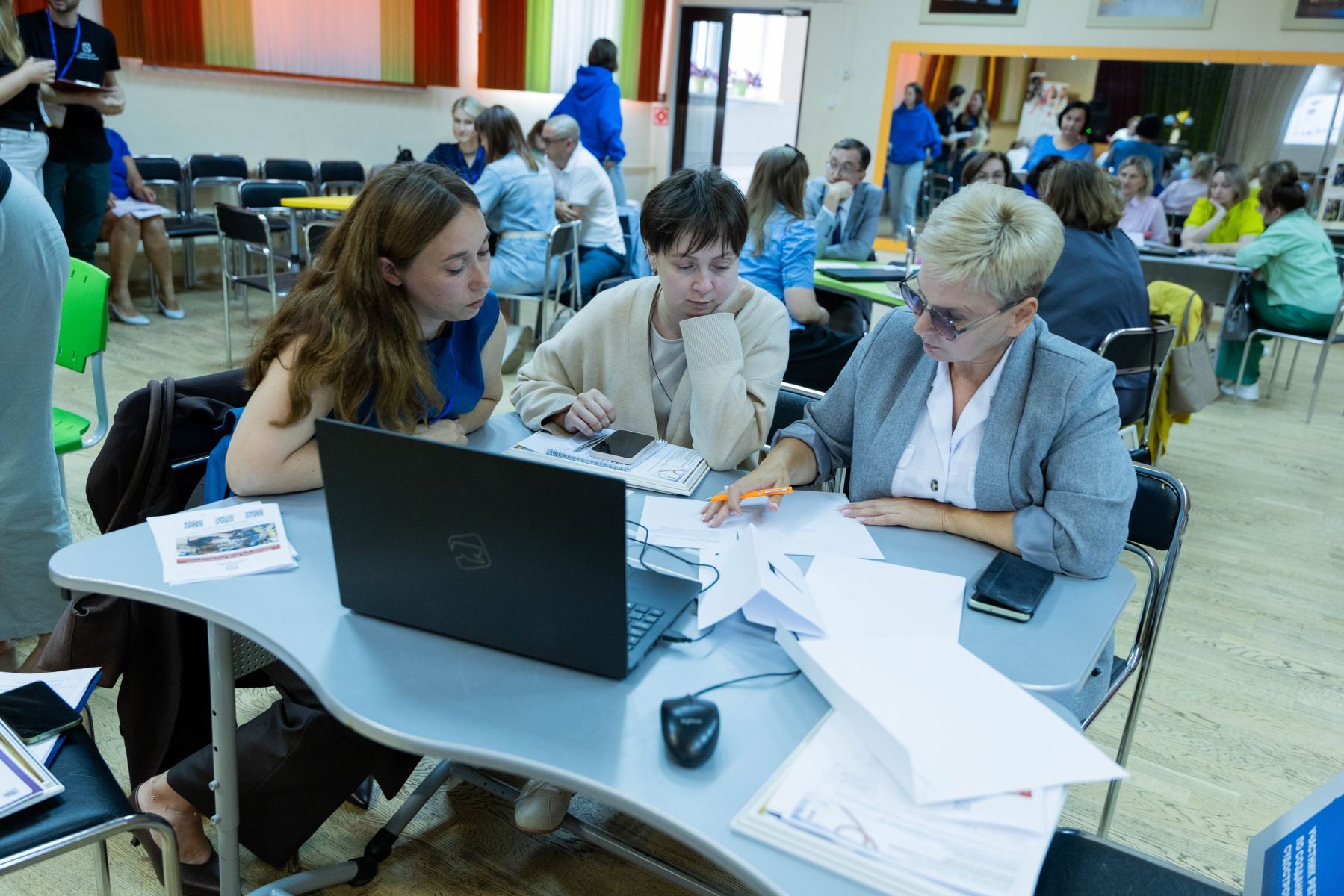
On 19 August, a strategic project session entitled Shipbuilding Engineering Classes: From Effective Solutions to Sustainable Development took place at the university’s partner school, MAEI Secondary School No. 31. The event took place as part of the August Pedagogical Conference and focused on current issues relating to the development of shipbuilding engineering classes.
The Department of Education Modernisation at the Ministry of Education of the Kaliningrad Region and Kaliningrad State Technical University organised the event. L.N. Boltneva, the director of MAEI Secondary School No. 33, moderated the session.
E.I. Ivanova, director of School No. 31, I.N. Pozdnyakova, head of the Department of Education Modernisation at the Ministry of Education of the Kaliningrad Region, and V.I. Ustich, Vice-Rector for Academic Affairs at KSTU, addressed the participants with welcoming remarks.
As part of the business programme, presentations were given by representatives of the IT Club from lyceum No. 18, the secondary school in the village of Grachevka, and Immanuel Kant Baltic Federal University, who shared their experiences of implementing educational programmes and organising online collaboration.
During the project intensive course, E.N. Gashenko, director of the Centre for Pre-University Projects at KSTU, presented the educational programme for the university’s new grant-funded project, Shipbuilders of the Future. Three modules have been developed for pupils in grades 9–11: Fundamentals of Ship Design Theory, Ship Modelling and Fundamentals of Electrical Engineering. The outcome of the training will be the creation of a functioning radio‑controlled model of a ship and participation in the engineering competition Amber Regatta. For students in grades 7–8, a propaedeutic course called Young Engineer is available, featuring master classes and mentoring by students from KSTU.
The project’s industrial partners are JSC PSZ Yantar Shipyard, JSC 33 Ship Repair Plant and OOO Kliver.
Group work proved to be a key element of the event. The participants were divided into teams, each of which was given an envelope containing a case study. Over the course of an hour, the teams worked through problem scenarios simulated by the organisers, which were relevant to specialist engineering classes.
The topics of the case studies covered a wide range of issues:
- - the optimal age for starting a shipbuilding class (from grade 1, 5, 7 or 10) — the teams presented arguments ‘for’ and ‘against’ for each year group;
- - engagement with the parent community — convincing arguments for parents concerned about their children being isolated, an increased workload and the shipbuilding programme not being in demand;
- - creating a regional roadmap for the development of shipbuilding classes, including activities for pupils, teachers and parents, with the involvement of academic, industrial and educational partners;
- - study programmes for pupils as part of the We Are Russians programme;
- - sharing the experience of establishing shipbuilding classes with other regions: participants analysed the project’s strengths and weaknesses and proposed areas for development.
The organisers also proposed the idea of creating a Young Shipbuilder’s Library — a collection of books, films and visual materials that are essential for study in engineering classes. The group moderators were E.A. Chureev, A.D. Kmet, S.A. Ponomareva, V.S. Khanevich, I.A. Aleksanova and E.N. Gashchenko.
The strategic session concluded with a summary of the working groups’ findings and an assessment of the solutions developed. All proposals will be considered when drawing up a roadmap for joint activities between KSTU and schools in the region as part of the Shipbuilders of the Future project.